2018Mar 14
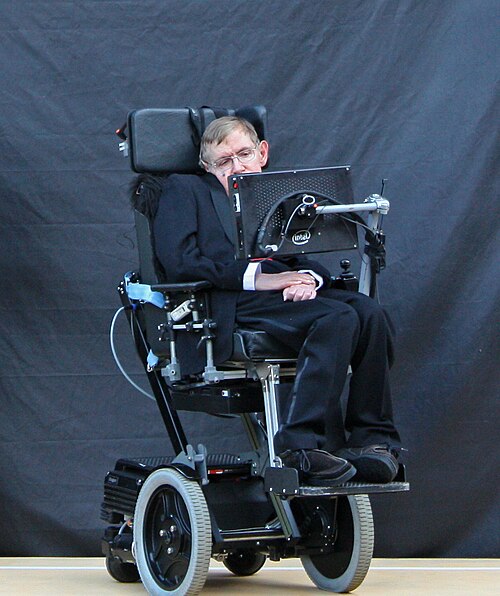
Stephen Hawking
is an English theoretical physicist and cosmologist, whose scientific books and public appearances have made him an academic celebrity. Born 8 Jan 1942 - Died 14 Mar 2018 Oxford 2 recorded health events
Stephen Hawking was an English theoretical physicist and cosmologist whose work on black holes, and whose bestselling books, made him one of the most recognised scientists of his time. He was born on January 8, 1942, in Oxford, to Frank and Isobel Hawking, into a family of physicians, and was educated at St Albans School in Hertfordshire.
He entered University College, Oxford, in October 1959 at 17 and took a first-class degree in physics, then moved to Trinity Hall, Cambridge, where he earned a PhD in applied mathematics and theoretical physics in 1966. With Roger Penrose he developed singularity theorems within general relativity. In 1974 he argued that black holes give off radiation, an idea first dismissed by some colleagues and now known as Hawking radiation, and that same year the Royal Society elected him a Fellow. From 1979 to 2009 he held the Lucasian Professorship of Mathematics at Cambridge, and he later served as director of research at the university's Centre for Theoretical Cosmology. His popular book A Brief History of Time held a place on the Sunday Times bestseller list for 237 weeks, a record.
His later honours included the US Presidential Medal of Freedom and a lifetime seat in the Pontifical Academy of Sciences, while a 2002 BBC poll ranked him 25th among the 100 Greatest Britons. He lived for more than 50 years after his diagnosis with motor neurone disease, and he died at home in Cambridge on March 14, 2018, aged 76, in what his family described as a peaceful death. Following a service of thanksgiving at Westminster Abbey on June 15, 2018, his ashes were placed in the nave between the graves of Isaac Newton and Charles Darwin.
Health Timeline
Newest first - 2 eventsAbout this record
Each event is compiled from published reporting and rated for severity by an automated classifier, then shown with its date. Only events concerning Stephen Hawking's own health are included. Biographical summary adapted from Wikipedia (source linked above).
2 health events - 0 articles tracked