1883Mar 14
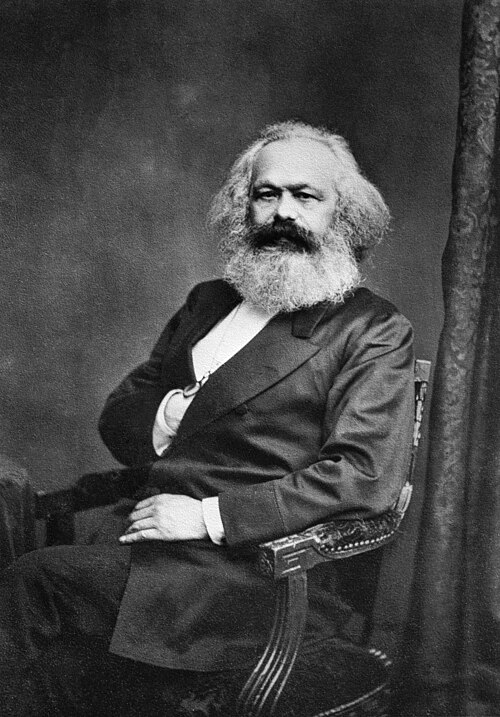
Karl Marx
The founder of scientific socialism, an economist, thinker and revolutionary. Born 5 May 1818 - Died 14 Mar 1883 Trier 4 recorded health events
Karl Marx was a German philosopher, journalist and revolutionary socialist whose theory of historical materialism, with its forecast that communism would eventually replace capitalism, became the core of Marxism. He was born on May 5, 1818, in the Prussian city of Trier. In 1836 he became engaged to Jenny von Westphalen, a childhood acquaintance from the petty nobility.
Marx earned a philosophy doctorate at Jena in 1841 and moved to Cologne the next year as a journalist on the radical Rheinische Zeitung. In Paris he wrote the Economic and Philosophic Manuscripts of 1844, and there his partnership with Friedrich Engels began. After moving to Brussels, both worked within the Communist League, and in 1848 they issued The Communist Manifesto, a program for revolution. Forced out of Germany after the upheavals of that year, Marx settled in London. In the British capital he filled the Grundrisse notebooks and wrote Das Kapital, a three-volume critique of classical political economy, which appeared between 1867 and 1894.
He also took a leading role in the First International, formally the International Workingmen's Association. His ideas, extended by later followers, went on to inspire revolutionary movements in many countries. From 1881 a catarrh left him in poor health, and it brought on the bronchitis and pleurisy of which he died, in London, on March 14, 1883, at age 64, by then a stateless man. Family and friends buried him on March 17, 1883, in the eastern part of Highgate Cemetery, in a section set aside for agnostics and atheists.
Health Timeline
Newest first - 4 eventsAbout this record
Each event is compiled from published reporting and rated for severity by an automated classifier, then shown with its date. Only events concerning Karl Marx's own health are included. Biographical summary adapted from Wikipedia (source linked above).
4 health events - 0 articles tracked