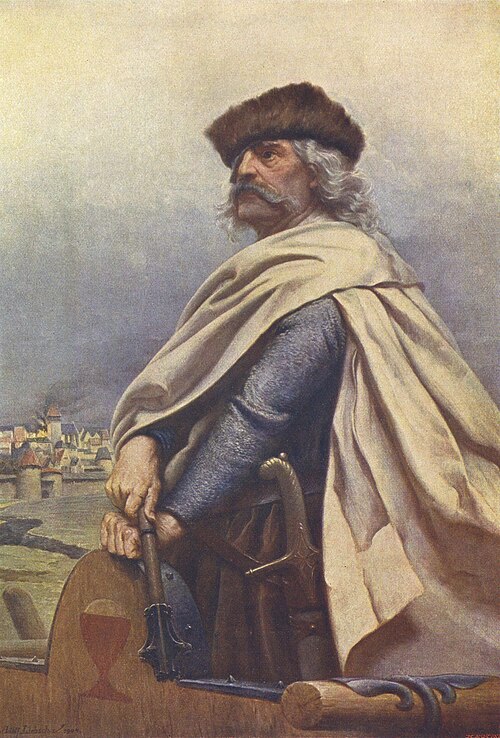
Jan Žižka
Jan Žižka was a Czech knight and military commander who led the radical Taborite wing of the Hussites during the Hussite Wars and is honored today as a Czech national hero. He was born around 1360 at Trocnov, a Bohemian village, to a family of minor Czech nobles. One later account says he served as chamberlain to Queen Sophia of Bavaria, the wife of King Wenceslaus IV.
On July 15, 1410, he fought at the Battle of Grunwald, where he helped defend Radzyń against the Teutonic Order. His first major mark on events came in Prague on July 30, 1419, when he joined the Hussite procession that ended in the First Defenestration of Prague, the episode usually taken as the start of the Hussite revolution. In 1420 he commanded Hussite troops at Sudoměř and at Vítkov Hill. At Kutná Hora in 1421 he beat the combined forces of the Holy Roman Empire and the Kingdom of Hungary, and his field guns proved their worth against the royal cavalry. Across three crusades sent against the Hussites, he never lost a battle.
His methods broke with the habits of the age. He put small cannons and hand cannons on armored wagons, the so-called wagon forts, and relied on scouting and clever use of the ground when open cavalry charges were standard, drawing his soldiers from nobles, militias and peasants alike. His tactics are now seen as early examples of guerrilla and asymmetric warfare and are taught at military academies around the world. At an assembly in Čáslav Tábor chose him as one of its pair of delegates. Žižka died on October 11, 1424.
Health Timeline
Newest first - 0 eventsNo health events recorded for Jan Žižka yet. This page updates as coverage is verified.
About this record
Each event is compiled from published reporting and rated for severity by an automated classifier, then shown with its date. Only events concerning Jan Žižka's own health are included. Biographical summary adapted from Wikipedia (source linked above).
0 health events - 0 articles tracked