1946
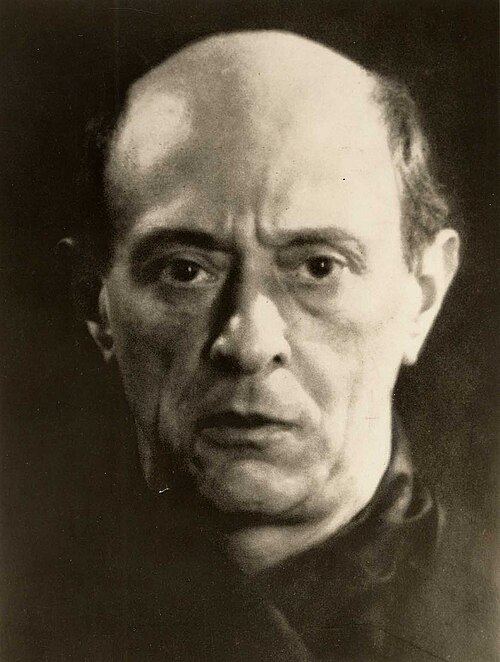
Arnold Schoenberg
Austrian composer and painter, associated with the expressionist movement in German poetry and art, and leader of the Second Viennese School Born 13 Sep 1874 - Died 13 Jul 1951 Vienna 1 recorded health event
Arnold Schoenberg was a modernist composer, music theorist, and teacher who developed variation, the emancipation of the dissonance, and twelve-tone composition. He taught composition in Vienna and at the Prussian Academy of Arts, and later at the University of California, Los Angeles, mentoring notable composers such as Anton Webern and Alban Berg. Schoenberg's early works, like Verklärte Nacht and Gurre-Lieder, synthesized the styles of Johannes Brahms and Richard Wagner, while his later works, such as String Quartet No. 2 and Erwartung, explored atonality and expressionism. He arrived at the twelve-tone technique by 1923 and structured works like Moses und Aron and the Variations for Orchestra using row-derived intervallic motives. Schoenberg's innovative music was influential and widely debated, shaping generations of composers, including Milton Babbitt and Pierre Boulez, and his aesthetic and music-historical views influenced musicologists like Theodor W. Adorno and Carl Dahlhaus. His legacy is collected at the Arnold Schönberg Center, which preserves his archival legacy and continues to inspire new generations of musicians and composers.
Health Timeline
Newest first - 1 eventAbout this record
Each event is compiled from published reporting and rated for severity by an automated classifier, then shown with its date. Only events concerning Arnold Schoenberg's own health are included. Biographical summary adapted from Wikipedia (source linked above).
1 health event - 0 articles tracked